WHAUP plans renewable energy expansion as Thailand prepares new power plan
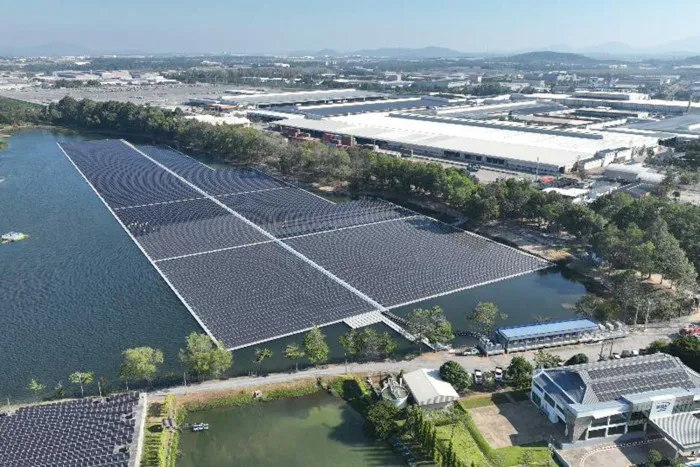
The company has started two solar projects totalling 14 megawatts for Auto Alliance (Thailand) in Rayong.
WHA Utilities and Power Plc (WHAUP) is planning to enlarge its renewables business alongside Thailand’s proposed Power Development Plan. Scheduled to cover 2026 to 2050, the plan includes a government goal for renewables to supply 50% of power generation within its first decade.
Chief executive Akarin Prathuangsit said WHAUP had recently put two solar projects into commercial service for Auto Alliance (Thailand). Located in Rayong at the Eastern Seaboard Industrial Estate, the installations have a combined capacity of 14 megawatts (MW): 6MW on rooftops and 8MW from floating solar.
Akarin said the projects should meet about 25% of the automaker’s electricity requirements and lower its emissions and energy bills. Auto Alliance, the joint venture of Mazda and Ford, already draws around 25% of its power from renewable sources. It has announced plans to raise that share to 100% by 2035.
WHAUP supports a government proposal to pilot direct power purchase agreements under the 2026 plan, allowing renewable electricity producers to supply industrial customers directly. Thailand currently prohibits peer-to-peer electricity trading. Akarin said permitting surplus power sales between industrial estates could open additional opportunities.
The WHA Corp utility and power subsidiary is also investing in facilities in the Eastern Economic Corridor that reclaim industrial wastewater for reuse. Alongside its energy expansion, WHAUP has set a 2026 sales target of up to 170 million cubic metres of water for industrial customers.